Three evenings ago I was playing darts with Amit 'Babumoshai'. After a couple of minutes of throwing the darts towards the board, we realized that though the game is fun, we could not compare who scored better since neither of us knew how scoring is done in the game. So we decided that one of us will have to find out how scoring is done in the game of darts. That evening, the game witnessed amazing feats by the players…like the one dart (of the three) which was propelled beyond the room and through the window with the help of my throw. We never found it again..maybe it struck a squirrel sleeping on the trees just outside the window…maybe it pierced a crow’s buttocks as it was dozing off on the branch…maybe it landed on a pile of ….anyway, it was gone for good and we knew it. But that didn’t stop us from playing with the 2 remaining darts. The game finally ended 15 minutes before the start of the second World Cup Football match of the day (Tunisia and Saudi Arabia).
So I went to google.com the next day and found some interesting facts about the game darts. Darts is a game, or rather a variety of related games, in which darts are thrown at a circular target (dart board) hung on a wall. Though various different boards and games have been used in the past, the term 'darts' usually now refers to a standardized game involving a specific board design and set of rules.
So I went to google.com the next day and found some interesting facts about the game darts. Darts is a game, or rather a variety of related games, in which darts are thrown at a circular target (dart board) hung on a wall. Though various different boards and games have been used in the past, the term 'darts' usually now refers to a standardized game involving a specific board design and set of rules.
As well as being a professional competitive sport, darts is a traditional pub game, commonly played in the United Kingdom (the first to officially recognize darts as a sport), the Netherlands, Israel, the Scandinavian countries, the United States and elsewhere.
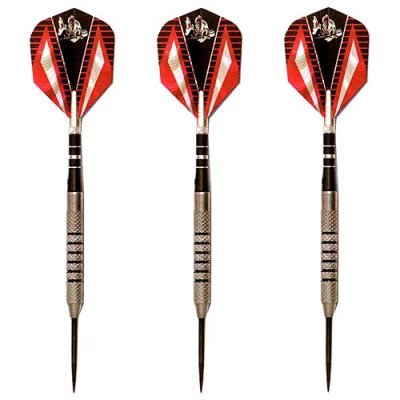 DARTS
Dart Boards:
Dart boards are usually made of sisal fibers and each section is lined with thin metal wire. The numbers indicating the various scoring sections of the board are normally made of wire, especially on tournament-quality boards, but may be printed directly on the board instead.
Height and distance:
In the standard game, the dart board is hung so that the bullseye is 5 ft 8 in (1.73 m) from the floor, eye-level for a six foot man. The oche (pronounced 'ock-ey'), or throwing line behind which the player must stand, is 7 ft 9.25 in (2.37 m) from the face of the board, though a few British pubs set it at 8 ft (2.44 m) or 8 ft 6 in (2.59 m).
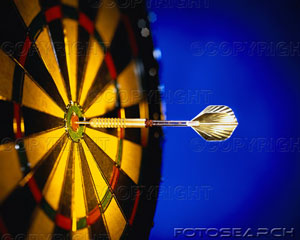 DART BOARD
History:
The dartboard itself may have its origins in the cross section of a tree, although some historical records suggest that the first standard dartboards were the bottoms of wine casks, hence the game's original name of "butts" (Aha…this is interesting). There is speculation that the game originated among soldiers throwing short arrows at the bottom of the cast or at the bottom of trunks of trees. As the wood dried, cracks would develop, creating "sections". Soon, regional standards emerged and many woodworkers supplemented bar tabs by fabricating dart boards for the local pubs.
The dartboard itself may have its origins in the cross section of a tree, although some historical records suggest that the first standard dartboards were the bottoms of wine casks, hence the game's original name of "butts" (Aha…this is interesting). There is speculation that the game originated among soldiers throwing short arrows at the bottom of the cast or at the bottom of trunks of trees. As the wood dried, cracks would develop, creating "sections". Soon, regional standards emerged and many woodworkers supplemented bar tabs by fabricating dart boards for the local pubs.
The numbering plan known by many today has a 20 on top; however, a great many other configurations have been used throughout the years and in different geographical locations. By most accounts, the numbering layout was devised by Brian Gamlin in 1896 to penalize inaccuracy. Although this applies to most of the board, the left-hand side (near the 14 section) is preferred by beginners, for its concentration of larger numbers.
Scoring:
The standard dartboard is divided into twenty numbered sections, scoring from one to 20 points, by wires running from the small central circle to the outer circular wire. Circular wires within the outer wire divide each section into single, double and triple areas. Various quite different games can be played (and still are played informally) using the standard dartboard. However, in the official game, any dart landing inside the outer wire scores as follows: a. Hitting one of the large portions of each of the numbered sections, traditionally coloured black and yellow, scores precisely the points value of that section.
b. Hitting the thin outer portions of these sections, coloured red and green, scores double the points value of that section.
c. Hitting the thin inner portions of these sections, roughly halfway between the outer wire and the central circle and again coloured red or green, scores triple (or 3x) the points value of that section.
d. The central circle is divided into a green outer ring worth 25 points (known as "outer" or "outer bull") and a red inner circle (usually known as "bull", "inner bull" or "double bull"), worth 50 points. The term "bullseye" can mean either the whole central part of the board or just the inner red section.
e. Hitting outside the outer wire scores nothing.
f. Any dart that does not remain in the board after throwing (for example, a dart that hits a wire and bounces out of the board or drops out with the impact of a later throw) also scores nothing. Variations on this rule exist - some judge that a dart which obviously hits a scoring section but then subsequently drops out will count if caught before it hits the floor or if it rebounds behind the throwing line before touching the ground it may be thrown again. In professional rules, a dart's tip must be touching a scoring section for the dart to count.
g. The highest score possible with 3 darts is 180, obtained when all three darts land in the triple 20. In the televised game, the commentator frequently announces a score of 180 in exuberant style.
Playing darts:
A game, or "leg", of darts is usually contested between two players who take turns in throwing up to three darts. Starting from a set score, usually 501 or 301, a player wins by reducing his score to zero. The last dart in the leg must hit either a double or the inner portion of the bullseye, which is the double of the outer bull, and must reduce the score to exactly zero. Successfully doing so is known as "doubling out" or "checking out". A throw that would reduce a player's score to one or below zero does not count, his turn ends, and his score is reset to what it was before that turn. Since the double areas are small, doubling out is usually the most difficult and tense part of a leg. Longer matches are often divided into sets, each comprising some number of legs.
A game, or "leg", of darts is usually contested between two players who take turns in throwing up to three darts. Starting from a set score, usually 501 or 301, a player wins by reducing his score to zero. The last dart in the leg must hit either a double or the inner portion of the bullseye, which is the double of the outer bull, and must reduce the score to exactly zero. Successfully doing so is known as "doubling out" or "checking out". A throw that would reduce a player's score to one or below zero does not count, his turn ends, and his score is reset to what it was before that turn. Since the double areas are small, doubling out is usually the most difficult and tense part of a leg. Longer matches are often divided into sets, each comprising some number of legs.
Of the two professional organisations, the British Darts Organisation (BDO), founded 1973, is the older. Its tournaments are often shown on the BBC in the UK. The BDO is a member of the World Darts Federation (WDF) (founded 1976), along with organisations in some 60 other countries worldwide. The BDO organises all British darts players, with the exception of a small group of professionals.
In 1994 a breakaway organisation was formed, initially known as the World Darts Council (WDC) but shortly after known as the Professional Darts Corporation (PDC). Over the years a continued exodus of top players from the BDO has established the PDC as the home of Professional Darts. An influx of sponsors and rapid expansion of television coverage continues. Tournaments are broadcast in the UK on Sky Television, and in the Netherlands by Sport One with many other tv stations now involved across the globe.
The PDC tournaments often have higher prize money and without doubt the best player in the world - 13 times World Champion Phil Taylor. Cementing the PDC's dominance at the very top of the game in early 2006, four times BDO world champion Raymond van Barneveld moved to the PDC.
Professional competitions:
The major tournament within both the PDC and BDO organisations are the World Championships which take place at the start of each year. The BDO tournament has been running since 1978, the PDC tournament since 1994 and in 2006 the first prize offered and total prize fund of the PDC World Championship was double that offered by the BDO tournament. (£100,000 to the PDC Champion, £50,000 to the BDO Champion).
The other main professional tournaments are ; Darts Premier League, UK Open, Las Vegas Desert Classic, World Matchplay, World Grand Prix (PDC - all televised live and in their entirety)
International Darts League, World Darts Trophy, World Masters (BDO/WDF - with the former two only broadcast on Dutch tv (SBS6), and the latter broadcast on SBS6 and by the BBC in the UK)
The WDF World Cup (for national teams) has been played bi-annually since 1977.
Other facts:
(a). The American Darters Association offers league organization for casual singles players throughout the United States (http://www.adadarters.com/)
(b). The American Darts Organization is the world's largest national dart league, facilitating the organization of members' regional divisions, and promoting the sport via pub-based teams and individuals across the country (http://www.adodarts.com/)
(c). World Champion: Raymond van Barneveld Barney - 4 times BDO World Champion


